
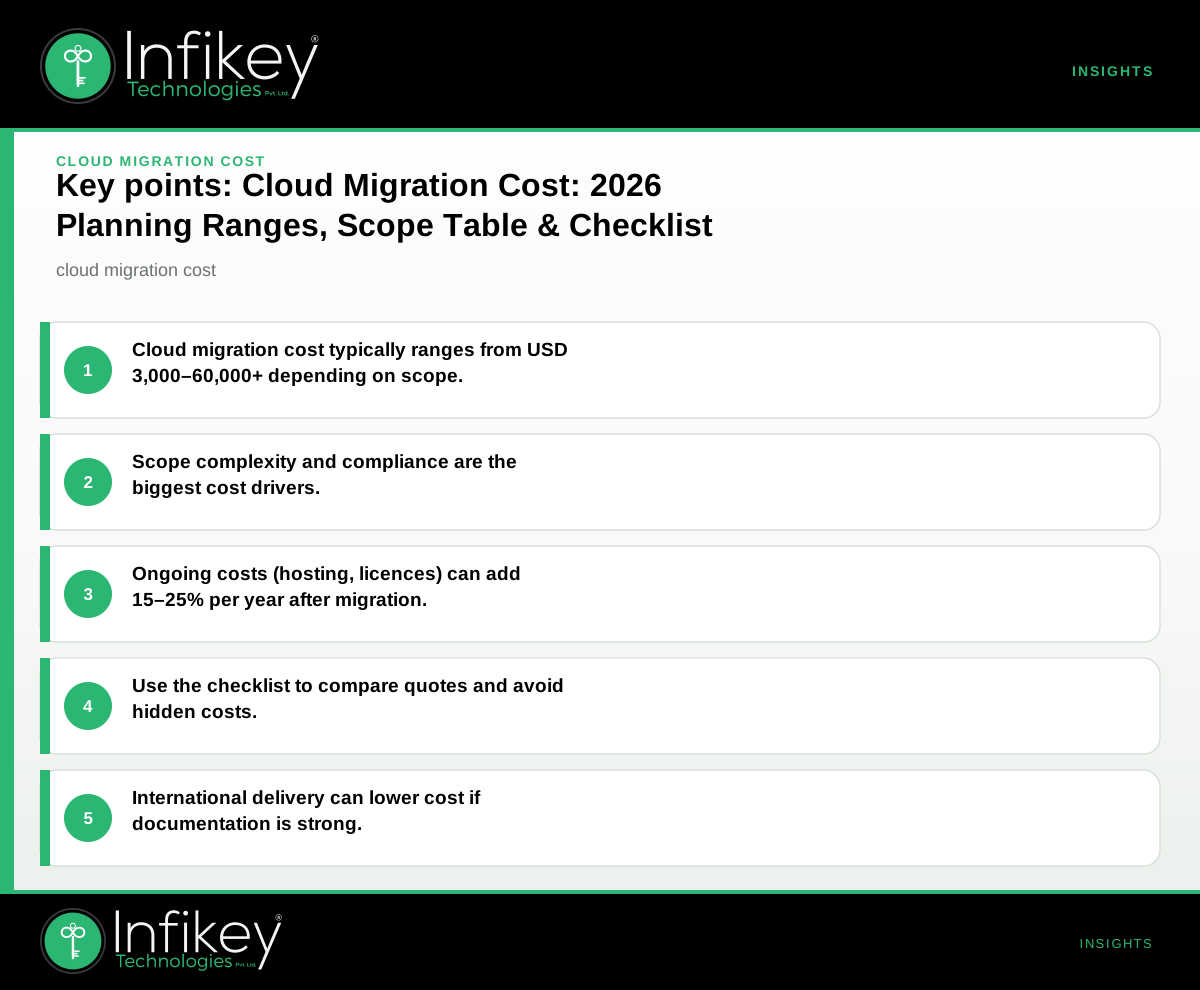
Cloud migration cost for most businesses falls between USD 3,000–15,000 for a targeted infrastructure sprint, or USD 15,000–60,000+ for a full custom migration. The biggest factor is the scope—whether you’re moving a handful of workloads or rebuilding your platform. Final pricing is always confirmed after discovery, but these planning ranges are a realistic starting point for an international audience.
Cloud Migration Cost Table: Scope, Range & Timeline
| Scope Tier | What is Included | Planning Range (USD) | Typical Timeline |
|---|---|---|---|
| Infrastructure Hardening Sprint | Review, CI/CD, monitoring, backups, security baseline | 3,000–15,000 | 2–6 weeks |
| Full Custom Migration (Web App/Portal) | Auth, roles, dashboards, integrations, staging + production | 15,000–60,000+ | 8–20 weeks |
Decision rule: If your migration is limited to infrastructure setup and security, budget for the lower tier. If you’re moving custom applications or portals, expect the higher range.
What Drives Cloud Migration Cost Up or Down?
Cloud migration pricing is influenced by several core factors, which can increase or decrease your overall investment. Understanding these drivers helps you plan and compare cloud migration quotes effectively:
- Scope Complexity: The more workloads, integrations, or custom applications you need to migrate, the higher the cost. A simple lift-and-shift of standard workloads is at the lower end of the range, while complex, multi-tier migrations with dependencies push costs up.
- Existing Environment: Legacy systems, undocumented infrastructure, or heavy on-premise customisations require additional effort to assess, refactor, or replatform. This increases both the time and the cost of migration.
- Cloud Provider & Services: Your choice of cloud provider (AWS, Azure, GCP, or hybrid) impacts tooling, licensing, and available managed services. Leveraging advanced services such as AI, analytics, or managed databases will add to the cloud infrastructure cost.
- Security & Compliance: Industries like financial services, healthcare, and the public sector must meet strict regulatory requirements. Enhanced controls, audit trails, and documentation increase the migration effort and cost.
- Data Volume & Migration Approach: Moving large datasets or requiring zero-downtime (live) migration demands more sophisticated tooling and planning, which increases cost.
- Testing & Cutover Planning: Comprehensive testing, rollback strategies, and staged cutover are essential for risk mitigation, but they add to the project scope and budget.
- Team Location & Delivery Model: Offshore or remote delivery (such as through [Infikey Technologies](/) Pvt. Ltd. in Ahmedabad) can reduce costs, but requires strong documentation and communication to avoid delays or misunderstandings.
Example Cloud Migration Project: Phases & Ballpark
To illustrate how cloud migration pricing is structured, consider a mid-sized retailer aiming to migrate its e-commerce portal and supporting databases to the cloud, modernise CI/CD, and add monitoring. Here’s how a typical project breaks down:
- Phase 1: Discovery & Assessment (2 weeks)
- Inventory of current systems, risk assessment, and scope definition - Included in planning
- Phase 2: Infrastructure Hardening (2–4 weeks)
- CI/CD pipeline setup, monitoring, security baseline - Ballpark: USD 3,000–15,000
- Phase 3: Application Migration & Integration (6–12 weeks)
- Migrating applications, setting up authentication, dashboards, integrations, and environments for staging and production - Ballpark: USD 15,000–60,000+
- Phase 4: Testing & Cutover (2–4 weeks)
- User acceptance testing, rollback planning, go-live support - Included in above ranges
Total planning range: USD 18,000–75,000+ depending on complexity and final scope. These ranges reflect typical cloud migration agency pricing for international delivery, with the final quote confirmed after a detailed discovery phase.
Example Engagements: What Do Cloud Migration Agencies Deliver?
When you engage a cloud migration company like Infikey Technologies Pvt. Ltd., you can expect a structured process and transparent pricing. Here are two common project shapes, with ballpark figures and timelines based on Infikey Technologies Pvt. Ltd.’s experience:
1. Infrastructure Hardening Sprint
- Scope: Review of existing infrastructure, setup of CI/CD pipelines, monitoring, backup strategy, and security baseline.
- Planning Range: USD 3,000–15,000
- Timeline: 2–6 weeks
- Best For: Organisations looking to prepare their current workloads for the cloud or secure their initial cloud environment.
2. Full Custom Web Application Migration
- Scope: Migration of a custom web application or portal, including authentication, role management, dashboards, third-party integrations, and both staging and production environments.
- Planning Range: USD 15,000–60,000+
- Timeline: 8–20 weeks
- Best For: Businesses migrating complex or business-critical applications, especially those requiring custom integrations and enhanced security.
For more details on these services, see [[Cloud and infrastructure]({{service:cloud-and-infrastructure](/services/cloud-and-infrastructure))}}.
Ongoing and Hidden Costs After Migration
The initial cloud migration cost is only part of the total investment. After migration, several ongoing and sometimes hidden costs must be considered to maintain and optimise your cloud infrastructure:
- Cloud Hosting & Storage: Monthly fees are based on actual usage, storage, and bandwidth. These costs can fluctuate as your business grows or usage patterns change.
- Licences & Subscriptions: Operating systems, databases, or third-party tools may require new or upgraded licences in the cloud environment.
- Maintenance & Monitoring: Ongoing support, patching, and performance monitoring are essential for cloud operations. These can be managed in-house or outsourced to a managed engineering partner.
- Change Requests & Enhancements: Any business changes after go-live (such as adding new features or integrations) are typically not included in the original migration cost and are billed separately.
Tip: As a rule of thumb, allocate at least 15–25% of your initial migration cost annually for ongoing support, optimisation, and cloud infrastructure cost management.
How to Lower Cloud Migration Cost Without Compromising Quality
Reducing cloud migration cost is possible without sacrificing quality if you follow a disciplined approach:
- Prioritise Workloads: Start with non-critical systems to gain experience and reduce risk before moving mission-critical workloads.
- Automate Where Possible: Use migration tools and infrastructure as code to streamline data transfer and environment setup, reducing manual effort and errors.
- Clarify Scope Early: Document exactly what is included in the project scope to avoid scope creep and unexpected expenses.
- Leverage Remote Teams: International delivery models, such as those offered by Infikey Technologies Pvt. Ltd. in Ahmedabad, can deliver quality outcomes at competitive rates if communication and documentation are strong.
- Opt for Managed Services: Where suitable, use cloud-managed databases, monitoring, and security services to reduce operational overhead and long-term costs.
Comparing Cloud Migration Quotes: What to Ask
When evaluating cloud migration quotes from different agencies or companies, ask these questions to ensure you’re comparing apples to apples:
- What workloads and applications are included in this scope?
- Does the quote cover both infrastructure and application migration?
- Are security, compliance, and documentation included in the price?
- What is the approach to testing, rollback, and cutover?
- How are ongoing support and change requests handled and priced?
- What assumptions are made about your existing environment and data volume?
- How will time zones, handover, and communication be managed if working with a global or remote team?
A reputable cloud migration agency will provide clear answers and a detailed breakdown of their cloud migration pricing, including any exclusions or assumptions.
The Role of a Cloud Migration Company: Why Work with Experts?
A specialised cloud migration company brings experience, best practices, and proven frameworks to your project. Working with experts like Infikey Technologies Pvt. Ltd. ensures:
- Structured Discovery: Thorough assessment of your current environment and requirements
- Transparent Pricing: Clear cloud migration quotes with defined scope and deliverables
- Risk Management: Robust security, compliance, and rollback planning
- Post-Migration Support: Ongoing optimisation and support to manage cloud infrastructure cost
For organisations in regulated industries such as financial services, healthcare, or public sector, partnering with an experienced provider is critical for compliance and business continuity.
Next Step: Estimate Your Cloud Migration Cost
For a tailored estimate, use Infikey’s cloud migration cost savings calculator or [[contact Infikey]({{contact](/contact))}} to discuss your specific needs. For detailed scope, international delivery, and to understand how we help manage your cloud migration cost, see our Cloud and infrastructure service page.
Cloud migration cost is best managed with clear scope, realistic planning ranges, and a delivery partner who documents every step. Use this guide to set your budget, compare cloud migration pricing, and choose a partner with confidence.