
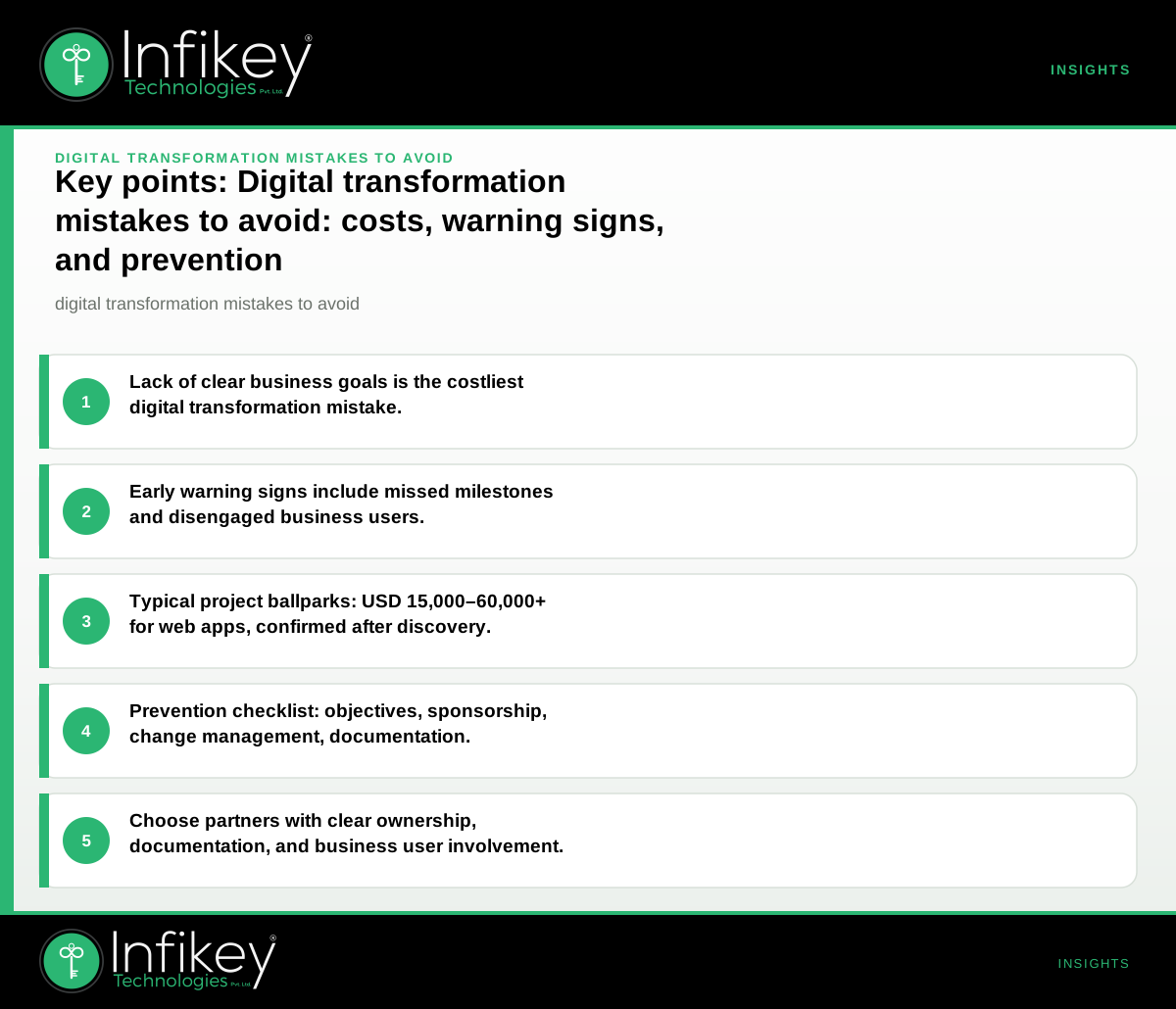
The most expensive digital transformation mistake is launching without clear business goals and executive sponsorship. This leads to wasted spend, missed outcomes, and stalled projects. To avoid it, define measurable objectives, secure leadership commitment, and ensure every decision links back to business value.
Table: Common Digital Transformation Mistakes, Costs, and How to Avoid Them
| Mistake | Why it happens | What it costs you | How to avoid it |
|---|---|---|---|
| No clear business objectives | Rushed planning, tech-first mindset | USD 15,000–60,000+ in wasted scope | Set measurable goals and link every feature to outcomes |
| Lack of executive sponsorship | Leadership not engaged or aligned | Project stalls, budget overrun | Secure C-level buy-in and regular steering meetings |
| Underestimating change management | Focus only on tech, ignore people/process | Low adoption, rework, morale issues | Invest in training, comms, and user involvement |
| Over-customising off-the-shelf solutions | Desire for unique features, lack of roadmap discipline | Higher costs, upgrade pain | Stick to core features, use configuration over custom code |
| Poor vendor or partner fit | Rushed selection, unclear requirements | Delays, scope creep, integration issues | Run a structured RFP, check references, clarify ownership |
| Inadequate documentation and handover | Delivery focus, skip knowledge transfer | Dependency on vendor, support gaps | Insist on clear docs and staged handover |
On projects like this, we usually see the biggest budget overruns and delays when objectives are vague, or when leadership treats digital transformation as an IT-only initiative.
Understanding Digital Transformation Mistakes to Avoid
Digital transformation is not just about technology—it's about aligning people, processes, and platforms to achieve measurable business value. The most common digital transformation mistakes to avoid stem from a lack of strategic clarity, insufficient change management, and poor partner selection. Each of these areas can introduce significant digital transformation project risks, including cost overruns, missed deadlines, and low adoption rates.
A successful digital transformation requires:
- Clear articulation of business goals
- Executive sponsorship and ongoing engagement
- Robust change management in digital transformation initiatives
- Careful selection of technology and partners
- Ongoing measurement and course correction
Let’s break down these critical areas and how to address them.
Early Warning Signs Digital Transformation Projects Are in Trouble
Spotting early warning signs digital transformation projects are going off track can save months of wasted effort and budget. Watch for these red flags:
- Project milestones keep slipping without clear reasons. Delays without root-cause analysis often indicate scope confusion or lack of ownership.
- Business users are disengaged or unclear on the benefits. If end users aren’t involved, adoption will suffer.
- Decisions are made by IT in isolation from other departments. Siloed decision-making leads to misaligned priorities and poor outcomes.
- Change requests pile up, but the business case for each is weak. This signals a lack of upfront planning or shifting objectives.
- Documentation is missing, incomplete, or never reviewed by your team. Poor documentation creates support and scaling risks.
- Vendor or partner communication becomes reactive instead of proactive. If your partner is only responding to issues, not preventing them, project risks increase.
If you see two or more of these signs, pause for a health check before spending further. Early intervention is key to mitigating digital transformation project risks.
Digital Transformation Mistakes to Avoid: Prevention Checklist
A prevention-first mindset is essential. Use this checklist to steer clear of common pitfalls:
- Define measurable business outcomes. Tie every feature and milestone to a business metric, such as reduced manual effort or increased customer engagement.
- Secure executive sponsorship and regular steering. Ensure C-level leaders are visible and involved in key decisions and reviews.
- Map current processes and pain points with business users. Bring stakeholders into workshops to document as-is workflows and pain points.
- Limit customisation—prioritise configuration and proven patterns. Avoid building unnecessary custom features that add cost and complexity.
- Select partners based on fit, transparency, and delivery track record. Assess partners for domain expertise, communication style, and willingness to share references.
- Plan for change management: training, communications, and support. Budget for user training, ongoing communication, and feedback loops.
- Insist on clear documentation and staged handover. Ensure knowledge transfer is built into the project plan.
- Review scope and budget at each milestone—adjust before overruns. Use phased delivery and regular reviews to keep projects on track.
Change Management in Digital Transformation: Why It Matters
Change management in digital transformation is often underestimated, yet it’s one of the biggest drivers of project success or failure. Technology alone does not guarantee adoption—people need to understand, accept, and champion new ways of working.
Best practices for change management:
- Engage stakeholders early. Involve users from the start to gather input and build buy-in.
- Communicate the ‘why’. Explain the business rationale behind the transformation, not just the technical details.
- Provide hands-on training. Offer role-based training sessions and easy-to-access resources.
- Create feedback channels. Set up regular check-ins and anonymous feedback options to surface concerns early.
- Celebrate quick wins. Highlight early successes to build momentum and reinforce positive change.
Ignoring change management leads to low adoption, resistance, and ultimately, failed digital transformation outcomes.
How to Choose a Digital Transformation Partner
Selecting the right partner is a critical decision that shapes your project’s trajectory. Here’s how to choose a digital transformation partner who aligns with your goals and reduces risk:
- Assess technical and domain expertise. Does the partner have experience in your industry and with your chosen technology stack?
- Evaluate transparency and communication. Look for partners who provide clear documentation, regular updates, and open escalation paths.
- Check for structured discovery and delivery processes. A good partner runs structured workshops, defines clear milestones, and uses agile or phased delivery.
- Review their track record. Ask for references, case studies, and details on how they handle challenges.
- Ensure cultural and geographic fit. For global projects, confirm the partner can work across time zones, currencies (USD, INR), and communication styles.
- Clarify ownership and handover. Make sure the partner commits to comprehensive documentation and knowledge transfer at project close.
Contact Infikey for a structured approach to partner selection and delivery.
Digital Transformation Project Risks: What to Watch For
Every digital transformation project carries risks. The most common digital transformation project risks include:
- Scope creep. Uncontrolled expansion of requirements leads to delays and budget overruns.
- Integration complexity. Connecting new systems with legacy platforms can create unexpected technical challenges.
- Vendor lock-in. Over-customising solutions or skipping documentation can make you dependent on a single vendor.
- Change fatigue. Too many changes at once can overwhelm teams and reduce morale.
- Inadequate testing. Rushed launches without comprehensive testing risk introducing critical defects.
How to mitigate these risks:
- Use phased delivery and regular scope reviews.
- Invest in integration planning and proof-of-concept pilots.
- Insist on open standards and clear documentation.
- Pace change initiatives and provide support resources.
- Build in time for user acceptance testing and go-live support.
What Does a Digital Transformation Project Typically Cost?
Digital transformation project cost varies by scope, complexity, and delivery model. For planning purposes, here are typical Infikey engagement ballparks:
- Custom web application/portal: USD 15,000–60,000+ (8–20 weeks)
- Scope: Authentication, roles, dashboards, integrations, staging + production environments
- Mobile app (iOS + Android): USD 12,000–45,000 (10–18 weeks)
- Scope: MVP features, authentication, core flows, API integration, store submission support
- Marketing website: USD 4,000–12,000 (4–8 weeks)
- Scope: Design system, 8–15 pages, CMS, basic SEO, forms
Final scope and commercials are always confirmed after a structured discovery phase. These ranges reflect typical Infikey engagements for global buyers, with remote delivery, clear documentation, and milestone-based billing. See Digital transformation for more details.
Example Project Shapes and Timelines
- A mid-market retailer rebuilding a catalogue site: 4–8 weeks, USD 4,000–12,000
- A healthcare provider digitising care operations: 8–20 weeks, USD 15,000–60,000+
- A manufacturer connecting plant-floor data to dashboards: 10–18 weeks, USD 12,000–45,000
Final pricing is always tailored after discovery and requirements mapping.
Questions to Ask Before Approving Your Digital Transformation Budget
Before you commit to any spend, use these questions to pressure-test your plan:
- What are the top three business outcomes we expect?
- Who owns each milestone and decision?
- How will we measure adoption and ROI?
- What change management support is included?
- What happens if the project needs to pause or pivot?
- How will knowledge transfer and support be handled after launch?
- What are the early warning signs digital transformation is off track, and how will we address them?
Steps to Avoid Digital Transformation Mistakes: A Practical Guide
- Start with discovery. Map current state, pain points, and desired outcomes with all key stakeholders.
- Document a business case. Link every requirement to a business goal or metric.
- Build a phased roadmap. Prioritise quick wins and deliver value early.
- Choose the right partner. Use structured RFPs and reference checks to assess fit.
- Invest in change management. Budget for training, communication, and support.
- Monitor progress with clear metrics. Use dashboards and steering meetings to review progress and course-correct.
- Plan for handover and support. Ensure documentation and staged handover are built into the project plan.
Next Step: Get a Digital Transformation Plan You Can Approve
Avoiding digital transformation mistakes starts with clear goals, the right partner, and a prevention checklist. See Digital transformation for Infikey’s approach, or contact us to discuss your project before you commit budget.
---
[Infikey Technologies](/) Pvt. Ltd. delivers digital transformation, website development, mobile app development, software engineering, cloud and infrastructure, cybersecurity, AI, managed engineering, digital marketing and SEO, and graphics designing services for global clients from Ahmedabad. For a structured, risk-aware approach to your next project, talk to Infikey.